
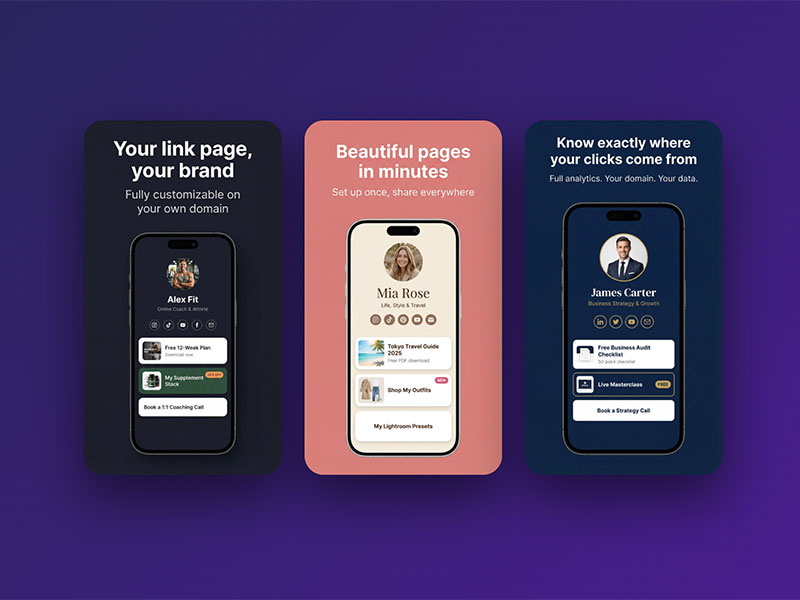
Overview
LinkBio Tracker is a WordPress plugin designed to help creators, businesses, and teams build their own link-in-bio pages directly on their website while improving link performance visibility and user experience.
The product addresses two key issues commonly experienced in social media traffic flows:
- In-app browser limitations (TikTok, Instagram, etc.)
- Inaccurate traffic attribution in analytics tools like GA4
This project was developed end-to-end, including product concept, positioning, UX design, development, pricing strategy, and go-to-market execution.
Problem
1. In-App Browser Limitations
Social platforms such as TikTok and Instagram force external links to open inside in-app browsers.
This causes:
- External apps not opening correctly
- Broken or inconsistent user flows
- Reduced conversion rates
2. Loss of Attribution in GA4
Traffic from social platforms often appears as “Direct” in GA4.
This leads to:
- Poor visibility into traffic sources
- Difficulty measuring campaign performance
- Misleading analytics data
3. Limitations of Existing Link-in-Bio Tools
Most existing tools:
- Are hosted on third-party platforms
- Offer limited customization
- Do not integrate well with owned analytics
- Do not support multi-page or multi-user use cases
Solution
LinkBio Tracker provides a self-hosted link hub system built on WordPress.
Core Approach:
- Create a centralized “link page” on the user’s own domain
- Improve user navigation flow from social platforms
- Enable clearer tracking of clicks and user behavior
Key Features
- Custom link-in-bio page builder on WordPress
- Click tracking and performance visibility
- Controlled user flow from social platforms
- Support for multiple pages (teams, projects, locations)
- Fully owned data and branding
Product Strategy
Positioning Shift
Instead of focusing only on “link in bio,” the product evolved into:
“A scalable link management system for creators, teams, and businesses.”
Target Segments
- Individual creators (basic link pages)
- Teams (sports teams, agencies, organizations)
- Multi-location businesses
- Multi-project creators and marketers
Differentiation
- Works on user’s own WordPress site
- Better control over tracking and attribution
- Designed for both individual and team use
- Flexible multi-page structure
Go-To-Market Strategy
Pricing Strategy
- Free plan (entry point)
- Pro: $49/year
- Lifetime: $149 (anchored)
Early Access Offer
- $29/year
- $99 lifetime
Used price anchoring and limited-time messaging to increase perceived value.
Marketing Angles
Two primary acquisition angles were tested:
1. Problem-Based (High Conversion)
- “In-app browser breaks your links”
- “Why your traffic shows as Direct in GA4”
2. Scale-Based (B2B Opportunity)
- “Manage link pages for your team”
- “Create multiple link hubs for your business”
Content Strategy
- Short-form posts (X, Instagram, Facebook)
- Problem-awareness posts
- Educational breakdowns
- Visual comparison creatives (before/after)
UX Approach
Instead of attempting to bypass platform restrictions, the product focuses on:
Improving the user journey rather than forcing technical workarounds
Example:
- Detect in-app browser context
- Guide users to open links in external browser
- Provide a cleaner intermediate navigation layer
Outcome
- Successfully launched as a working WordPress plugin
- Established multiple market positioning angles
- Identified strong demand in creator tools and team-based link management
- Built a scalable pricing and feature structure
Key Learnings
- Platform constraints (like in-app browsers) cannot always be bypassed—but can be designed around
- Perceived value matters more than raw pricing
- Problem-based messaging significantly outperforms feature-based messaging
- “Multiple pages” becomes valuable when framed as team or business scale, not just features
- Early-stage products benefit more from user acquisition and feedback than immediate revenue
This project involved
- Product ideation and validation
- UX / feature design
- WordPress plugin development
- Pricing strategy and monetization design
- Marketing and positioning strategy
- Landing page and content creation
Tools & Stack
- WordPress (plugin development)
- JavaScript / PHP
- Freemius (monetization)
- GA4 (analytics considerations)
- Social media platforms (distribution & testing)