
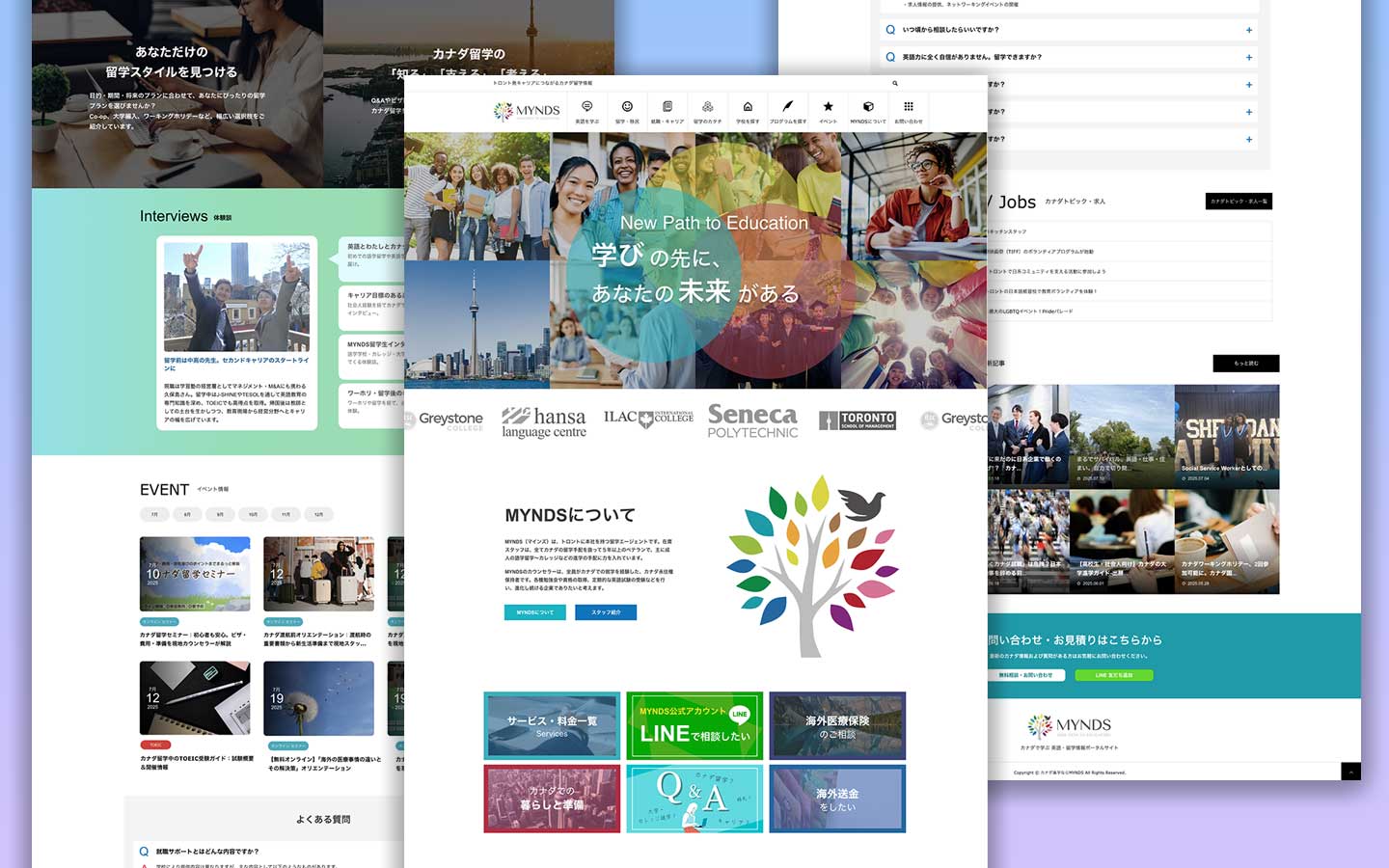
MYNDS is a Canada-based study abroad support business serving Japanese users. As the market environment shifted and the client’s business structure changed, the website also needed to change.
The existing site had grown into a large, content-heavy structure, but it was no longer functioning effectively as a conversion-focused business website. The goal of the renewal was to rebuild the website around a clearer service message, a more intuitive content structure, and a leaner operational model that could be managed by a small team.
Overview
This project focused on restructuring the MYNDS website to better align with the client’s updated business reality.
Rather than continuing to expand the site as a large information resource, the new direction emphasized a simpler, more strategic website structure designed to:
- communicate the service more clearly
- guide users toward inquiry
- reduce maintenance burden
- make better use of existing content
The work included website strategy, top page redesign, information architecture review, conversion flow improvement, WordPress implementation, and ongoing structural optimization.
The challenge
The existing website had several structural and strategic issues.
First, the site’s positioning was not immediately clear. The top page contained a large amount of information, but it did not clearly communicate that MYNDS was a study abroad support service. Depending on the user, it could be mistaken for an information portal or online magazine rather than a business website designed to generate inquiries.
Second, the site structure had become difficult to navigate and maintain. Categories and tags were inconsistent, some themes were grouped unclearly, and users were not always being guided toward the most important pages efficiently.
Third, the website was not producing stronger inquiry results despite years of operation. The path from content discovery to consultation was weak, and the post-inquiry flow, particularly around LINE, was not well integrated with the website experience.
At the same time, the client no longer wanted a site model that depended on frequent content production and constant expansion. The new website needed to be easier to maintain with fewer resources while continuing to support business goals.
The approach
The renewal was approached as a strategic restructuring project rather than a surface-level redesign.
The first step was to reassess the purpose of the website itself. Instead of treating the site as a broad content hub, the new direction repositioned it as a leaner, conversion-oriented platform built around the client’s core services.
From there, the focus shifted to clarifying the site concept, simplifying the information architecture, and rebuilding the user journey around inquiry generation. Special attention was given to the top page, which was redesigned to function more like a landing page: clearly explaining the service, surfacing the most important information, and improving the path to action.
The structure also needed to support reduced ongoing maintenance. Rather than relying on constant new updates, the site was rebuilt to work more effectively through stronger organization, better prioritization of key content, and more intentional internal pathways.
Key focus areas
Site repositioning
The site was restructured to better reflect MYNDS as a study abroad support business rather than an information-heavy media-style website.
Top page optimization
The homepage was rebuilt to improve first impressions, communicate the service more clearly, and direct users toward the most important next steps.
Information architecture
Categories, tags, and page hierarchy were reviewed and reorganized to create a more logical and user-friendly structure.
Conversion flow
The path from website visit to inquiry was strengthened, including clearer calls to action and improved integration with LINE-based consultation flow.
Sustainable content structure
The new structure was designed to remain effective without requiring large-scale ongoing updates, making it easier for a small internal team to manage.
What the work included
- Website strategy review
- Site concept clarification
- User flow planning
- Top page redesign and implementation
- Information architecture restructuring
- Category and tag optimization
- Conversion-focused CTA planning
- LINE inquiry pathway improvement
- Google Analytics conversion setup
- WordPress-based implementation and ongoing optimization
- Content selection and structural SEO support through existing content refinement
Technical and strategic implementation
This project combined content strategy, UX thinking, and practical website restructuring.
On the strategic side, the work focused on aligning the website with the client’s updated business model and reducing the gap between what users saw on the site and what the business actually offered.
On the implementation side, the renewal involved rebuilding the top page in WordPress, improving structural flexibility, refining content hierarchy, and supporting a setup that could be maintained with minimal future overhead. Conversion tracking and CTA placement were also considered as part of the rebuild so that the site could better support measurable inquiry behavior.
Outcome
The MYNDS renewal created a clearer, leaner, and more business-aligned website foundation.
Instead of continuing as a difficult-to-manage, content-heavy structure, the site was repositioned to better support service understanding, inquiry flow, and long-term maintainability. The result was a website more closely matched to both the client’s current operating reality and the needs of prospective users.
Services involved
Website Strategy / Information Architecture / Conversion-Focused Redesign / WordPress Development / CTA Optimization / Content Restructuring / Ongoing Website Support